

A position opens up on your team. You dig through a shared drive, dust off something that vaguely resembles a document from when the role was last filled three years ago, and paste it into LinkedIn.
Or maybe you’ve sat across from a frustrated employee in a performance review, referencing the glossy, benefit-forward job posting you wrote to recruit them. Only to realize it describes the role you were selling, not the role they’re actually doing.
If either scenario sounds familiar, you’re not alone. And you’re not careless. You just weren’t handed the right framework. Most business owners and managers use “job description” and “job posting” interchangeably. When they really aren’t.
Mixing up these two documents opens real legal exposure, muddies performance management, and signals to candidates that you’re not as organized as you’d like them to think. The fix is simpler than you’d expect: understanding what each document is actually for, and building each one with intention.
What Is a Job Description?
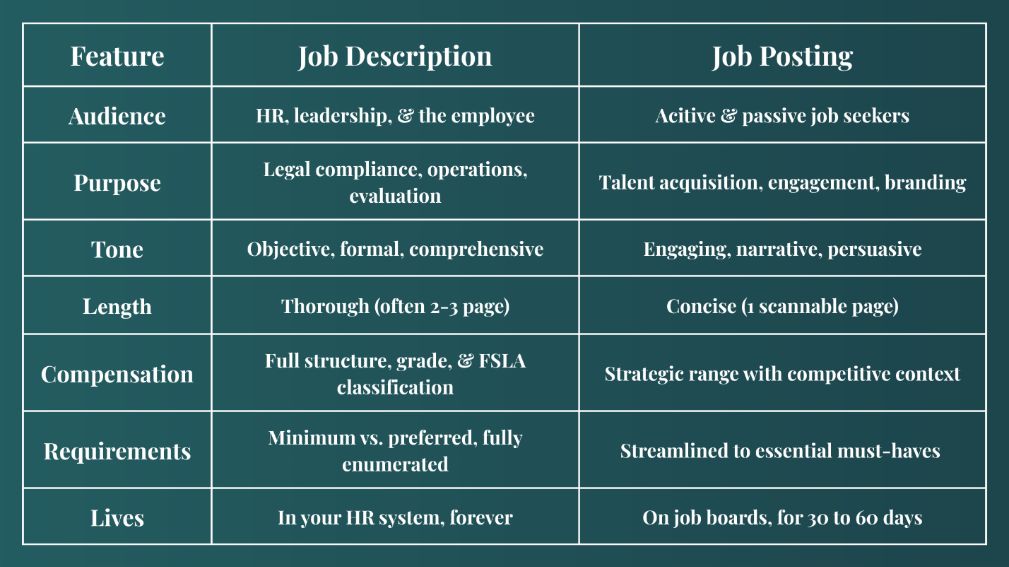
A job description is not a recruiting tool. It’s a formal, internal operational document. An internal organizational document that clearly defines a role from the inside out.
Think of it as the source of truth for everything that role means to your organization. It answers: What does this person actually do, day to day? What do they need to be able to do it? Where do they sit in the hierarchy? And what factors should be considered when making decisions related to compensation, accommodations, and performance expectations?
What Belongs in a Job Description:
- Daily responsibilities The actual tasks, decisions, and outputs the role owns.
- Strict minimum qualifications Hard requirements separated clearly from “nice-to-haves,” with legal defensibility in mind.
- Compensation considerations & FLSA status Relevant classification information, such as exempt vs. non-exempt status, along with alignment to your compensation structure
- Reporting structure Who this person reports to, and who (if anyone) reports to them.
Why it Matters Beyond Hiring
Where business owners tend to underestimate the job description’s power is that it doesn’t lose its usefulness once someone is in the seat.
A well-crafted job description is the foundation for every performance review, every promotion conversation, and every career development discussion. It tells you and the employee what success looks like. It also becomes an important piece of documentation when navigating ADA accommodation requests, FMLA considerations, and employment disputes.
What Makes a Good Job Posting?
Now flip the lens entirely. A job posting is not documentation. It’s essentially advertising copy. Its one job is to make a qualified candidate stop scrolling, feel something, and apply.
Where the job description is comprehensive and formal, the job posting is strategic and selective. You’re giving candidates a compelling reason to imagine themselves in your organization.
What Belongs in a Job Posting
- The hook: Culture, mission, and what makes your workplace genuinely different. Lead with the “why,” not the “what.”
- Impact-focused responsibilities: High-level outcomes, not an exhaustive task list. “You’ll own our customer onboarding experience” lands better than “performs onboarding tasks.”
- Simplified, realistic requirements: Lower the bar to the true minimum. This is especially important for attracting diverse, qualified talent who self-screen out unnecessarily.
- Clear call to action: Application instructions that are simple and specific. Make it effortless to say yes.
Treat your job posting like a piece of copy, not a compliance document. A posting that reads like a legal contract doesn’t attract great candidates.
The best postings read like an invitation. They answer the question every candidate is silently asking: “Why would I leave what I have to come work here?” Your posting needs to answer that before they even get to the requirements.
If your current postings open with “Responsibilities include…”, you’ve probably lost people before you’ve started.
Do I Have to Post Salary in a Job Posting?
If you have been operating under the same hiring practices for years, there is a good chance compensation requirements have changed since your last job posting.
Pay transparency laws have expanded across the U.S., with states such as Colorado, New York, California, Washington, and Illinois implementing requirements around when and how employers disclose compensation information. Additional requirements may also apply based on local regulations, the location where the position is posted, and where the employee will ultimately work.
That does not mean your public job posting should simply copy and past your internal compensation structure.
Internal pay grades, salary formulas, and compensation frameworks are designed to help your organization make consistent decisions. Sharing those details without context can create questions among current employees about how pay decisions are made and how individual roles are valued.
At the same time, leaving compensation information out of a job posting entirely may create compliance concerns depending on applicable state or local requirements.
The solution is creating a clear connection between your internal documentation and your external recruiting materials. Your job description should reflect the full details of the role, including relevant compensation considerations and classification information. Your job posting should communicate compensation information appropriately for candidates while providing enough context to help them understand the opportunity.
Two different documents. Two different audiences. Both supporting a stronger hiring process.
How to Use Both Documents to Hire Better and Stay Compliant
Smarter HR is about using the right tool for the right job. A job description and a job posting are both valuable, just in different contexts, to different audiences, for completely different reasons.
When you treat them as one document, you get a hybrid that serves neither purpose well. Too vague to manage performance, too dense to attract candidates, and too muddled to hold up under legal scrutiny. But when you treat them as two distinct tools built intentionally, updated regularly, and aligned with current compliance standards, you get something powerful. An operation that attracts the right people, manages them clearly, and protects your business at every stage of the employee lifecycle.
Of course, auditing your existing job descriptions, rewriting your postings, and staying current on pay transparency requirements takes time that most executives and founders simply don’t have. That’s exactly the kind of work that benefits from dedicated HR knowledge.
Whether you need to build the internal function from the ground up, clean up what already exists, or bring in an outside partner who already knows what to look for, Workforce Solutions brings the specialized HR experience to get it done right.
Ready to protect your business and land your next great hire?
If you need help reviewing your job descriptions, creating stronger postings, or building HR processes that support your growing team, Workforce Solutions can help.